 Gen AI Innovation

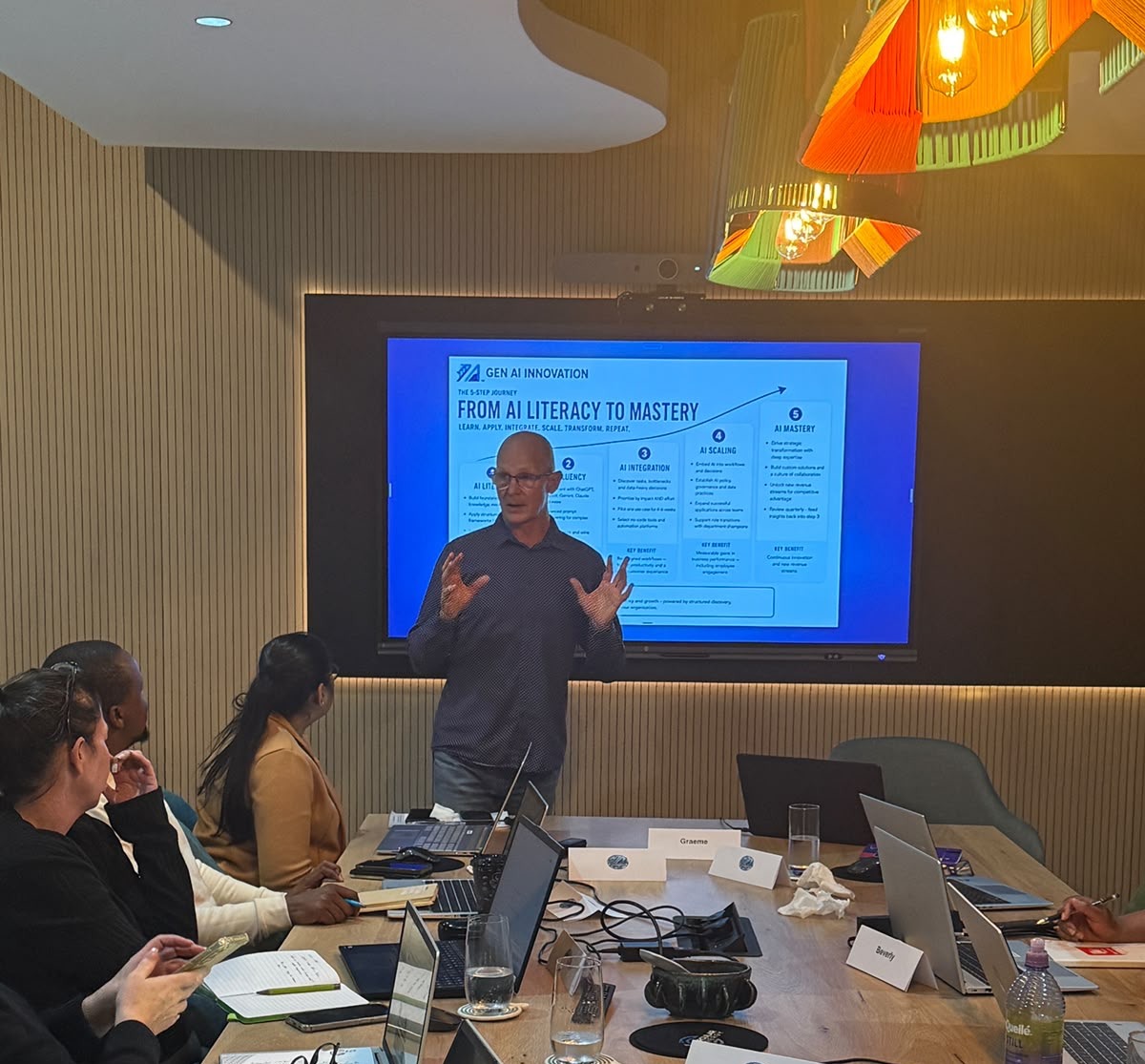
There's one number I pay more attention to than any other after a workshop: not attendance, not the energy in the room on the day, but what people say once they've had a chance to sit with it and reflect honestly. At Circular Energy last week, everyone who completed the feedback survey gave the training a 10 out of 10, both for value and for how likely they'd be to recommend it to a colleague.
Circular Energy is a not-for-profit driving South Africa's shift towards a circular economy, helping businesses meet their extended producer responsibility obligations for e-waste, batteries, lighting and packaging. It's detailed, compliance-heavy work, and the team in the room reflected that: delegates from Accounts Administration, Administration and Marketing, and Social and Municipal Coordination, each with different daily tasks and different starting points with AI.
The Approach
I took the group through the same framework that sits behind every workshop I run: AI Literacy to Mastery. We started with the basics of how Generative AI actually works, built into structured prompting, and then applied both directly to the tasks each delegate deals with day to day, reports, correspondence and content, rather than generic examples that don't stick once the laptop closes.
What Changed
The clearest theme running through every response was confidence. Not "I learned some new tools", but a genuine shift in how capable people felt sitting down to use AI for real work.
Wendile Luthuli, in Accounts Administration, put it plainly: "As much as I have attempted to use AI before, I was not as confident as I am now. I even know the different types of AI tools and their functions. Training was an eye-opener for me, and I now know more about prompts and notebooks."
Mcebo Zulu, Coordinator: Social and Municipal, found the same: "I feel more confident after the training. I can now use AI with correct prompts and can definitely assist me with my reports."
And Jordyn Mitchell, in Administration and Marketing, connected that confidence straight back to the job: "Before the training, I had a basic understanding of AI tools and their capabilities, but I was not always confident in how to use them effectively within my role. After the training, my confidence has increased significantly. I now have a much better understanding of how to prompt AI tools. This training will assist me by helping me save time on administrative tasks, improve the quality and speed of written communications, support event and project coordination activities, and enhance content creation for marketing and stakeholder engagement."
Three different roles, three different workloads, the same result: people who left more sure of what AI can actually do for them, and how to ask for it properly.
One Thing I'm Already Changing
The most useful line in the feedback wasn't praise, it was a suggestion. Jordyn recommended getting delegates pre-registered and signed up to the AI tools before the session starts, to streamline the process. She's right, and it's a small, easy fix I'm building into how I set up the next in-house session.
Where This Goes From Here
What struck me most about this group wasn't the score, it was the spread. A team this size, covering accounts, marketing and municipal coordination, doesn't have room for anyone to be "the AI person." Everyone has to be able to pick it up and use it in their own role, on their own tasks, without waiting on someone else. That's exactly what a 10 out of 10 from three such different roles actually means: the training worked at every level of the organisation, not just for the people who were already curious about AI.