 Gen AI Innovation
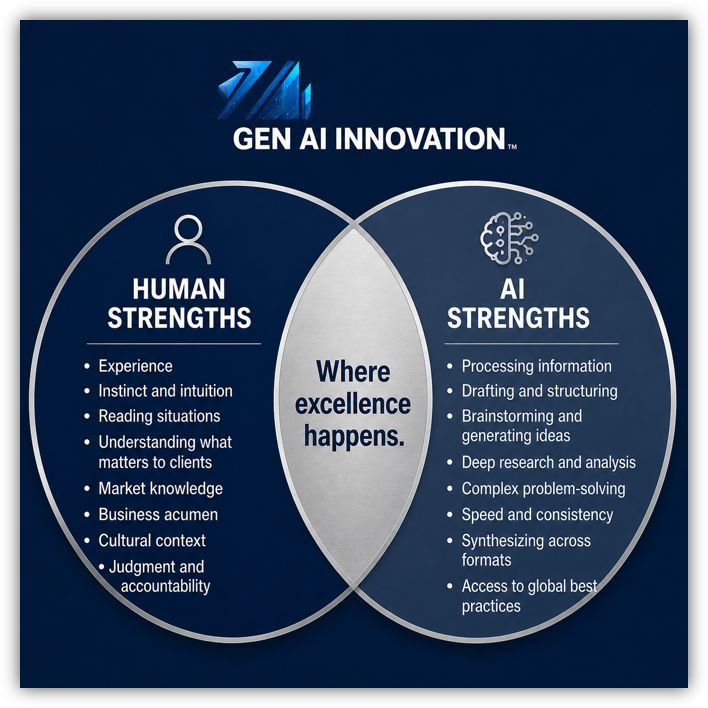
What happens when someone who is genuinely good at their work starts combining what they already know how to do well with what AI is genuinely good at?
Through two years of watching this play out, in workshops, in follow-up conversations, and in my own work, the answer isn't what most people expect. It isn't that they simply work faster. It's that they get measurably better at what they do.
What AI Is Actually Good At
Used well, AI is exceptional at a specific set of things:
- Processing information
- Drafting and structuring
- Brainstorming and generating ideas
- Deep research and analysis
- Complex problem-solving
- Speed and consistency
- Synthesizing across formats, video, audio, text
- Access to global best practices
It can take a large, messy pile of information and make sense of it quickly. It can hold several formats at once and pull the threads together. It doesn't get tired doing the tenth version of something, and it doesn't lose consistency on version eleven either.
What It Doesn't Have
What AI doesn't have is your experience. It doesn't have the instinct you've built over years for reading a room, sensing when something doesn't quite add up, or knowing what actually matters to your clients, as opposed to what looks good on paper. It doesn't understand how you do business, who you are, or where you come from.
That side of the equation is entirely human:
- Experience
- Instinct and intuition
- Reading situations
- Understanding what matters to clients
- Market knowledge
- Business acumen
- Cultural context
- Judgment and accountability
Neither list replaces the other. That's the point.
Where the Collaboration Actually Works
The professionals who get the most out of AI aren't the ones who use it the most. They're the ones who know their own strengths and gaps clearly, and who have a realistic, not inflated, not dismissive, understanding of what AI can and can't do. That clarity is what makes the collaboration work. Without it, you're either over-relying on a tool that doesn't know your business, or under-using a tool that could be doing real work for you.
Take a business owner working on a growth strategy. They bring the market knowledge, the intuition about what actually works locally, the understanding of their clients built up over years of doing business with them. They ask AI to research proven strategies globally, to challenge their thinking, and to surface approaches they might not have considered. Then they take all of that and refine it, through iteration, through conversation, back and forth, into something that's strategically sound and actually fits their business and their market.
Neither side could have produced that on its own. That's the collaboration that actually works.
Not a Silver Bullet
This isn't something that happens automatically the moment you open a chat window. It takes time and deliberate practice. You need to know your own strengths and gaps honestly. You need to know, just as honestly, what AI can and can't do. And you need to work systematically, not randomly, to operate in the space where the two overlap.
That overlap is where excellence happens. Not in the AI doing your job for you, and not in you ignoring what it's genuinely good at. Somewhere in the middle, where your judgment directs its capability.